Tag Archives: Rocky Fork State Park

$23 million road to nowhere

Last November, after three years of relative silence, the Tennessee Department of Environment and Conservation finally presented to the public their plans for the first stage of “improvements” in what was to be the “minimally developed” Rocky Fork State Park. Part of the plan is a 24-foot-wide, two-lane, paved road that begins with a bridge over Rocky Fork Creek and extends ¾ mile to a campground and scenic overlook on Flint Mountain.

The photo below shows the approximate route of the road, now estimated by TDOT to be a $23 million dollar project, designed so as to be able to accommodate RVs and 2,000 to 4,000 vehicles per day. Due to the rugged and steep terrain, extensive use of retaining walls, massive road cuts, and metal reinforcement bolted into rock on slopes above would be required, leaving an ugly scar on Rocky Fork. Also, take note of the fact that a future stage of this development would be to widen the existing Rocky Fork Road to similar standards, changing the “prettiest mile of road in Tennessee” forever.

If this isn’t what you want to see in Rocky Fork I suggest a letter to the new Commissioner of TDEC, David Slayers (David.Salyers@tn.gov) and/or the interim Deputy Commissioner of State Parks, Anne Marshall (Anne.Marshall@tn.gov), asking that these plans, developed by the previous administration, be re-visited and public input sought to arrive at a better plan that the public supports, before permanently damaging the natural beauty we worked so hard to protect.

Comments oppose development plan in Rocky Fork 60-2

Comment: Keep Rocky Fork primitive.

Comment: I am against making this park more developed.

Comment: Slow down, allow public input to help shape the plan for the park, and ensure that we “get it right” while we still have the chance.

Read all comments here.

In November, for the first time in three years, Tennessee State Parks staff came to Unicoi County and held a public meeting to discuss management of Rocky Fork State Park. State Park officials presented plans for a visitor center and an access road to a campground and a scenic overlook; these plans were presented in final form, only awaiting permits before construction would begin. 

The general feelings we heard from folks at the meeting included serious concerns about environmental damage as a result of the implementation of these plans, and discontent about the plans not being influenced at all by public input.  Evidence available seems to indicate that state parks staff are not very interested in the public’s opinion or input, but rather are simply satisfying a requirement to hold a public meeting and accept comments.

The public was invited to submit comments for the following 30 days. Later, I personally requested, twice, to review all comments submitted and did not receive a response, but, after the recent removal of Deputy Commissioner Brock Hill, asked again and did receive an incomplete collection of comments.

The comments are public information and are excerpted here for you to see what others think about the state’s plans, without identifying who provided each one. Roughly 60 comments vehemently oppose the plans presented with only two in favor. Contact us if you would like the unabridged versions.

Notably absent from the information provided by state parks were the comments submitted by a number of conservation organizations, all of whom opposed moving forward with the plans presented, including Southern Appalachian Highlands Conservancy, Tennessee Citizens for Wilderness Planning, The Sierra Club, The Wilderness Society, MountainTrue, and Wild South. A number of our friends’ comments were also missing (we add some here) but it is clear that the public is overwhelmingly opposed to the plans presented.

With this evidence that the public does not approve of the state’s plans, and the lack of public input to help shape those plans, we hope the new leaders will re-visit the issue before the heavy equipment moves in and changes Rocky Fork forever. We encourage you to send your letter to that effect to the new Commissioner of TDEC, David Salyers, Commissioner, Tennessee Department of Environment and Conservation and the acting Deputy Commissioner of State Parks, Anne Marshall (both at 312 Rosa L. Parks Avenue, Nashville, TN  37243). Letters to political leaders would be helpful as well including Governor Bill Lee, Senator Lamar Alexander, Congressman Phil Roe, and State Representative Rusty Crowe.

White House Cliffs Trail. Image by Van Hovey

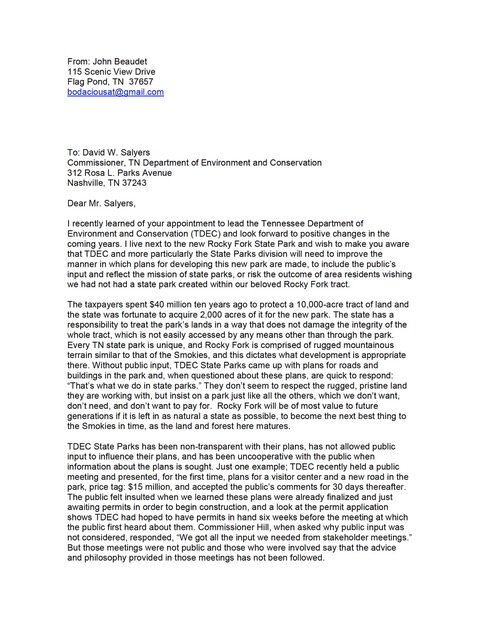
Sample Letter to New TDEC Leader

State parks in Tennessee are managed by a division of the Tennessee Department of Environment and Conservation, which, under new Governor Bill Lee, has a new commissioner: David Salyers. This change of leadership presents an excellent opportunity to write a letter asking for a review of the plans for Rocky Fork before any construction begins and permanent changes to the landscape are made. The letter I sent appears below. Feel free to use it as an example and write your own letter asking for proper care of this treasured place. If you need a little more background, here are the issues in a nutshell:

The mission of Tennessee State Parks begins with preserving and protecting the natural, cultural, and historic resources of the state. This mission goes on to include recreational use, but the intent is clear that such use shall not threaten those natural resources. 

Tennessee state parks are highly developed with inns, conference centers, restaurants, RV campgrounds, golf courses, swimming pools, rental cabins, marinas, etc. Rocky Fork State Park was promoted from the start as a “primitive, minimally developed” park, and because it is a small portion of the much larger Rocky Fork tract—10,000 acres protected for public use in 2008 at a cost of $40 million—the state should be obligated to live up to the original plan and not overdevelop the park to the detriment of the surrounding public lands.

Plans presented for the first step in developing the park include a two-lane paved road up Flint Mountain with an auto bridge over Rocky Fork Creek, a campground on the mountain (which will not include RVs “at this time”) a large visitor center where the current parking lot is, and widening of Rocky Fork Road. The state does not appear to be following the primitive, minimally developed philosophy we heard about early on.

Seven attend public meeting

Thursday, January 10, 2019, the Tennessee Department of Environment and Conservation, State Parks Division held a public meeting to discuss a proposal to acquire the Morrill Electric property within sight of the park entrance and apply for a grant from the EPA to clean up the contaminated site and redevelop it for the park’s use. Due to the fact that notice of this meeting was not released to the public until the day before the meeting, only five citizens participated along with one reporter from the Erwin Record and the park manager.

TDEC Grants Consultant Ryan Ray presented a proposal to apply for an EPA grant of $500,000 to clean up the site, projected to actually cost $618,000, the difference to be paid by TDEC. Although notice of this meeting alluded to the site being redeveloped into an equestrian trailhead, Ray confirmed that the grant is for cleaning up the site once TDEC acquires it and does not pertain to the precise purpose for which the site is then redeveloped.

Ray presented to the group of seven present some options for additional grants that would be pursued for funds to redevelop the site after cleanup and acknowledged that future use of the site was a separate issue and would be addressed at future public meetings and comment periods.

Although the small group seemed to all support the acquisition and clean up of the site, several questioned the future use as an equestrian trailhead and voiced opinions that the site would better serve the park as the visitor center location.

Ray reconfirmed that future use of the site is not dictated by the grant being applied for and that the various uses suggested other than as an equestrian trailhead could be considered by TDEC and discussed with the public at future meetings.

As for using the site as an equestrian trailhead, the park manager confirmed that TDEC has been working on a plan for a new horse trail into the park, which would start across the road from the site on property TDEC is working to acquire but does not yet own. One might wonder, if the park acquired land that would accommodate a new horse trail into the Flint Mountain area of the park, the same area as the proposed campground, perhaps auto access to the campground could be through that same property, thereby avoiding a great deal of environmental damage from construction of the currently proposed road to the campground area.

As for the reason for such short notice of this meeting, Ray said TDEC did not want to address the public on the topic until they were at least very close to a deal to acquire the property, and the grant sought has a deadline for application of January 31 so a very small window was available and the best he could do was a posting in the Erwin Record one day prior.

The acquisition and cleanup of this site seems to be a worthwhile project and very beneficial to the area and Unicoi County, which is currently stuck with an unusable contaminated site and could come away with a nicely redeveloped facility.

However, this will run into the millions of dollars and the future use of the site does create many questions that need to be addressed with further public input.

Public Hearing for January 10

With less than 24 hours notice, we have just received the message below from the Friends of Rocky Fork State Park about a meeting to be held tomorrow night, January 10, at the Flag Pond School, 917 Old Asheville Hwy, Flag Pond, TN.

“Hello Friend’s Members,

Tennessee State Parks will be conducting a public hearing tomorrow, Jan. 10th, at Flag Pond School at 6:00 p.m. 

This meeting is regarding proposed application for Brownfield clean-up funds from the United States Environmental Protection Agency.

Tennessee State Parks will receive public comments concerning the proposed action described below:

Facility Location:  Morrill Electric Building – 281 Jennie Moore Road, Flag Pond, TN  37657

Description:  Tennessee State Parks proposes to pursue funding through the United States Environmental Protection Agency’s Brownfield Clean-up Grant to facilitate the clean-up of the Morrill Electric Building site for redevelopment into an equestrian trailhead for Rocky Fork State Park.  The purpose of the hearing is to obtain views on parks needs, review proposed activities and solicit public comments.  The meeting is open to the public and all citizens are encouraged to attend and make their views known. 

Hope you are able to attend.

Thank You,

Marie Rice”

There have been discussions about this site being acquired and used for various purposes, and some feel it would make a better home for the new state park’s visitor center. Even though this is very late notice, we hope that some of you can attend the meeting.

I can’t believe I have a blog

A few years ago I had never used a computer, sent an email, or been on the internet—and certainly never expected to have a blog.

For years I had lived off-grid in the woods, spending most of my time backpacking all over the mountains—12,000 miles in all. Considering all the places I had hiked, I set down roots in the best place I had found; the mountains along the Tennessee–North Carolina border, just a little ways north of the Smokies in Flag Pond, TN.

I chose this spot carefully due to the large amount of protected land with only one missing piece: the 10,000-acre Rocky Fork tract. It was soon to be acquired by the government, completing a huge swath of protected land that would now be my backyard. I quickly purchased property within walking distance of the tract and built a little homestead.

Four years ago, a lovely new wife joined me in the off-grid cabin—bringing with her electricity, computers and the internet. That and the realization that protecting a special place would require continuous diligence ended my laid back, never-been-on-the-internet, just-grow-my-garden-and-hike-in-the-woods lifestyle.

Rocky Fork has a great deal of interesting natural and cultural history to be explored, but finding information about it all can be a challenge. And so I have started a blog, the Rocky Fork Journal, to help others learn more about my chosen backyard—the wild, remote, unspoiled Rocky Fork watershed.

Rocky Fork Creek by Joye Ardyn Durham

Please check out the journal. It’s a work in progress and I welcome your feedback. Feel free to forward this to others who may be interested.